Underworld Secrecy Law
My Vampire Love (Completed)The Underworld Secrecy Law is the institutional principle that keeps supernatural power concealed from ordinary human society while regulating how supernatural beings may act around humans and one another. In practice, it is less a neutral boundary than a system of jurisdiction: it determines who may intervene, who must guard, who may be sacrificed, and when supposedly binding protections can be overridden by authority. The law’s significance emerges most clearly when Katalin uses Underworld power to control Jenifer’s marriage and threatens the lives of her human family, showing that secrecy is maintained through coercion as much as concealment.
Jurisdiction and Restricted Protection
The law divides human and supernatural affairs into separate domains. Dean and his pack are assigned to guard Jenifer from Underworld matters only, a formulation that limits their mission while placing her under institutional supervision. Eric objects that Dean is one of the werewolves and could turn against them, but Katalin answers that he has no choice because the arrangement was ordered. The guardianship therefore functions not as personal protection freely chosen by Jenifer, but as an imposed legal duty whose terms are determined from above.
The same jurisdictional logic appears when Eric invokes the law against Katalin. He argues that she cannot touch him and would not dare harm Jenifer because of the blood in her veins. Katalin rejects that interpretation by asserting her superior rank as heir to the throne and by pointing out that Christy Wilson could carry Eric’s bloodline forward after his death. The exchange establishes that the law contains formal protections, but that those protections are conditional on status and bloodline. Katalin does not merely violate the system from outside it; she claims the authority to define its exceptions from within.
Secrecy as Governance
The law reaches beyond the concealment of supernatural existence. It organizes movement, surveillance, and intervention whenever the Underworld’s interests are involved. Dean’s pack is stationed near Jenifer because her life has become connected to Underworld politics, while Eric’s objections reveal the tension between intimate trust and official security. Even protection becomes a mechanism of control when the protected person has no authority over who watches her or why.
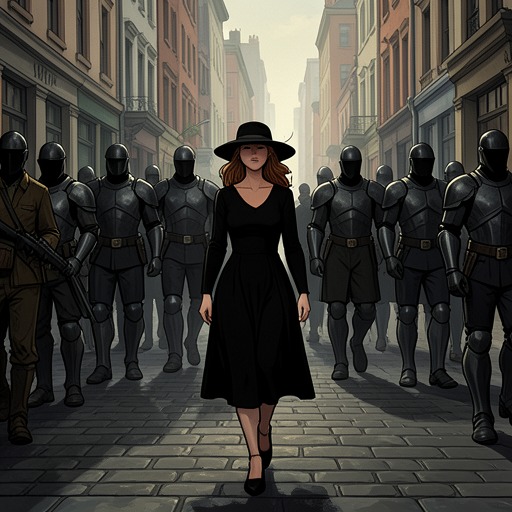
Katalin’s command that everyone arise and leave demonstrates the same structure at a larger scale. At the Wilson gathering, the vampires immediately obey her order, while the humans and a few pure-blood vampires remain standing until the room is cleared. The doors then close, leaving Jenifer, Eric, their parents, and Sophie isolated with Katalin. The public ceremony is transformed into a sealed chamber in which secrecy permits the ruler to strip away witnesses and ordinary social restraints. The law’s hidden world is consequently maintained through controlled access: people are admitted, removed, or confined according to supernatural authority.
Bloodline, Experiment, and Concealed Knowledge
The secrecy regime protects a political order founded on blood. Eric explains that vampires rule because of the power of pure-bloods, although witches once held control and power could shift among witches, shifters, and other supernatural species. To prevent such a change, the vampires began an experiment intended to create additional pure-blood vampires from humans. Every attempted subject died or suffered a worse result; Jenifer is the only living subject.
This information shows that secrecy conceals not only individual identities but also a state project designed to preserve supremacy. The experiment depends on carefully controlled amounts and timing of vampire blood. Too much blood too frequently creates a made vampire; too little can produce a coma or zombies. The law therefore operates alongside biological management: human bodies become classified subjects, and dangerous knowledge is restricted because it could expose the means by which the ruling species maintains power.
The hidden family archive gives this secrecy a historical dimension. Eric leads Jenifer into a vast stone room filled with hundreds of bookcases, glass showcases, and millions of names carved into walls and linked by vines. He identifies it as his family tree, reaching back to Lilith. Such records preserve the bloodline’s continuity while keeping its structure inaccessible to ordinary humans. The archive is both genealogy and political infrastructure, documenting the inheritance that gives figures such as Eric and Katalin their authority.
Exceptions, Punishment, and Sovereign Violence
The law’s claim to protect the Underworld is repeatedly accompanied by the removal of legal protection from selected beings. Dina explains that werewolves are called the Cursed Species because the inherited curse makes them transform during the week of the full moon, when they lose control and give in to bloodlust. Under Underworld law, they are supposed to be killed on sight. The rule treats the werewolves’ lack of control as grounds for execution, converting a condition of birth and transformation into a permanent legal category of threat.
Katalin applies a comparable logic to Jenifer. After sealing her inside a room, she lifts her from the floor by the throat and gives her an ultimatum: marry Eric or die, followed by the deaths of Eric, Jenifer’s human family, and her other connections. The threat presents forced marriage as an instrument of Underworld security. Jenifer is not treated as a person whose consent matters, but as a living asset whose bloodline, awakening, and relationships must be controlled.
The final confrontation makes the law’s emergency character unmistakable. Katalin removes the room’s occupants, traps the remaining witnesses, surrounds Eric with a shield of crystal-like projectiles, and then tells Jenifer to watch as she stabs Jenifer’s father at the base of the throat. The scene converts secrecy into an enclosed state of exception: ordinary rules are suspended, witnesses are isolated, and violence is staged as instruction. Katalin’s authority depends on making clear that the law can determine not only what must remain hidden, but whose life can be exposed to immediate destruction.
Narrative Significance
The Underworld Secrecy Law explains why personal relationships repeatedly become political matters. Daren’s relationship with Jenifer violates Katalin’s command that he remain only her friend, and his promise of a lifetime with Jenifer is treated as a breach of Underworld discipline. Eric’s relationship with Jenifer is likewise shaped by a larger arrangement that Katalin enforces through threats. The law turns romance, family, blood, and protection into connected legal instruments.
Its deepest contradiction is that secrecy is presented as necessary for collective survival while its enforcement produces the very instability it claims to prevent. The vampires fear losing supremacy to witches, shifters, or other species, so they conceal experiments, impose guardianship, regulate relationships, and authorize executions. Yet each protective measure intensifies resistance and exposes the brutality of the hidden order. The law thus functions not simply as a rule of silence, but as a structure of unequal visibility: supernatural society remains hidden from humans, while individuals inside it remain fully visible to the powers that govern them and vulnerable to violence whenever those powers declare an exception.